SHORT BIO
John Bernhard is a Swiss American artist, photographer, and writer whose work explores transformation, perception, and the poetic relationship between the human body and the natural world. His practice moves from dreamlike studies of the figure to contemplative explorations of trees and ecological presence. Bernhard is the author of eleven books, and his photographs are held in museum collections internationally.
FULL BIOGRAPHY
John Bernhard is a Swiss American artist, photographer, and writer whose multidisciplinary practice spans more than four decades and explores transformation, perception, and the evolving relationship between the human body and the natural world. Born and educated in Switzerland and later establishing his career in the United States, his work bridges European traditions of surrealist and poetic photography with an American engagement with landscape and environment. Across his practice, Bernhard moves from dreamlike interpretations of the figure to contemplative studies of trees and ecological presence, often unfolding through visual dialogues between images where meaning emerges through juxtaposition and association.
Bernhard traveled extensively across North America before settling in Houston, Texas in 1980. For more than four decades he has used photography to explore the everyday world from unexpected perspectives, developing a visual language that shifts between figurative, conceptual, and ecological investigations.
He was educated at the EPSIC Technical College in Lausanne and at the New York Institute of Photography. He is the author of eleven books including Nudes Metamorphs, Diptych, Drift, and his monograph Dreamlike Art and Deviation, a thirty-year retrospective of his photographic work.
Bernhard first gained recognition for early photographic series such as Skindream, Metamorphs, and Transformation, which explore the body as a site of dreamlike metamorphosis and perceptual transformation. Echoing elements of surrealist photography while developing a highly personal visual vocabulary, these works investigate identity as fluid and continually evolving.
Over time, this exploration of transformation expanded from the human body to the photographic image itself, and ultimately to the living structures of nature.
Running parallel to his figurative work, Bernhard developed conceptual projects including Diptych, Drift, and Unintentional, in which images are paired to create visual dialogues that invite associative interpretation and expand the narrative potential of photography. Portraiture also occupies an important place in his practice. Series such as MetamorFaces, Blue Marble, and Displaced explore identity and social presence through psychologically charged representations of human faces.
Bernhard’s recent work turns toward trees as a central metaphor. Series including Arboreal, Cartoon Arborealis, and What Persists reflect a growing engagement with ecological perception and the reflection on our natural world. Through close observation of trees, structure, and layered form, these works invite viewers to reconsider the quiet resilience of the natural world.
Beginning in 1985 with a solo exhibition at the Houston Center for Photography, Bernhard has presented more than thirty solo exhibitions, three museum exhibitions, and numerous group exhibitions throughout the United States, Canada, and Europe.
Bernhard’s photographs are included in more than twenty museum collections internationally, including the Minneapolis Institute of the Arts, Photo Elysée in Switzerland, the Pushkin Museum of Art in Moscow, the New Mexico Museum of Art, and the Museum of Fine Arts Houston.
In 2001 his work was included in Body Work, curated by Christian Peterson, a survey of photographs of the nude from the permanent collection of the Minneapolis Institute of Arts. In 2004 the Musée des Suisses dans le Monde in Geneva presented a retrospective of his work. His series Blue Marble debuted in a solo exhibition at Rice University in Houston in 2011.
Bernhard’s work has been reviewed in publications including Communication Arts, Graphis, Photo District News, The Houston Chronicle, and ArtSpeak Magazine, and has appeared in numerous books including Love & Desire by William A. Ewing.
Bernhard continues to expand his Arborealis project through photography, collages, and immersive installations that explore the relationship between perception, memory, and the living structures of trees.
John Bernhard lives and works in Houston, Texas.
HONORS
2024 Juror, ArtHouston Magazine Artist of the Year
2023 Juror, Archway Gallery's 15th Annual Juried Exhibition
2017-2021 Art Curator in Charge at Amegy Bank, where he has organized exhibitions featuring Sawyer Yards Artists, the largest creative campus in the United States, as well as a special showcase for Hispanic Heritage Month highlighting artists from Manteca, the nation’s first online directory of Latino creatives working in the visual arts.
2019 Juror, Houston Art Colony Association for the Annual Bayou City Arts Festival.
2000 Curator, Defrog Gallery / NASA, an inside look at the astronauts in space, STS-93 Space Shuttle Columbia.
1983-1985 Juror, Annual Science Fair of Houston, representing Eastman Kodak Co.
STATEMENT
My work develops through themes rather than isolated projects. I often pursue several lines of inquiry simultaneously, allowing ideas to evolve in parallel and inform one another. This approach reflects my interest in exploration, whether through essays, portraiture, studies of the human body, or conceptual photographic works.
Many of my projects move between dream and reality, between reflection and emotion. At the center of my practice is a fascination with transformation. I am drawn to moments of transition and change in people, bodies, memory, and the surrounding environment. Through photography, I explore how perception reveals subtle shifts in identity, nature, and time.
PROCESS STATEMENT
My photographic work begins in the studio, where I photograph the model using controlled lighting combined with projected images of natural elements I have previously photographed. These projected textures become part of the image at the moment of capture, allowing the body and the landscape to merge within the same visual field.
In my early practice I printed the photographs by hand in the darkroom before scanning them and combining them digitally with additional backgrounds and textures that I found, photographed, or created. This layering process gradually evolved into a hybrid approach that blends photographic capture, projection, and digital construction.
Today I continue to use projections as an essential part of the image-making process, while digital tools allow me to extend the layering of forms and textures. The resulting images emerge through the interaction of photography, light, and surface.
The final works are printed on museum-quality paper using archival inks, and occasionally on alternative materials such as wood, composite metal panels or custom surfaces that I create.
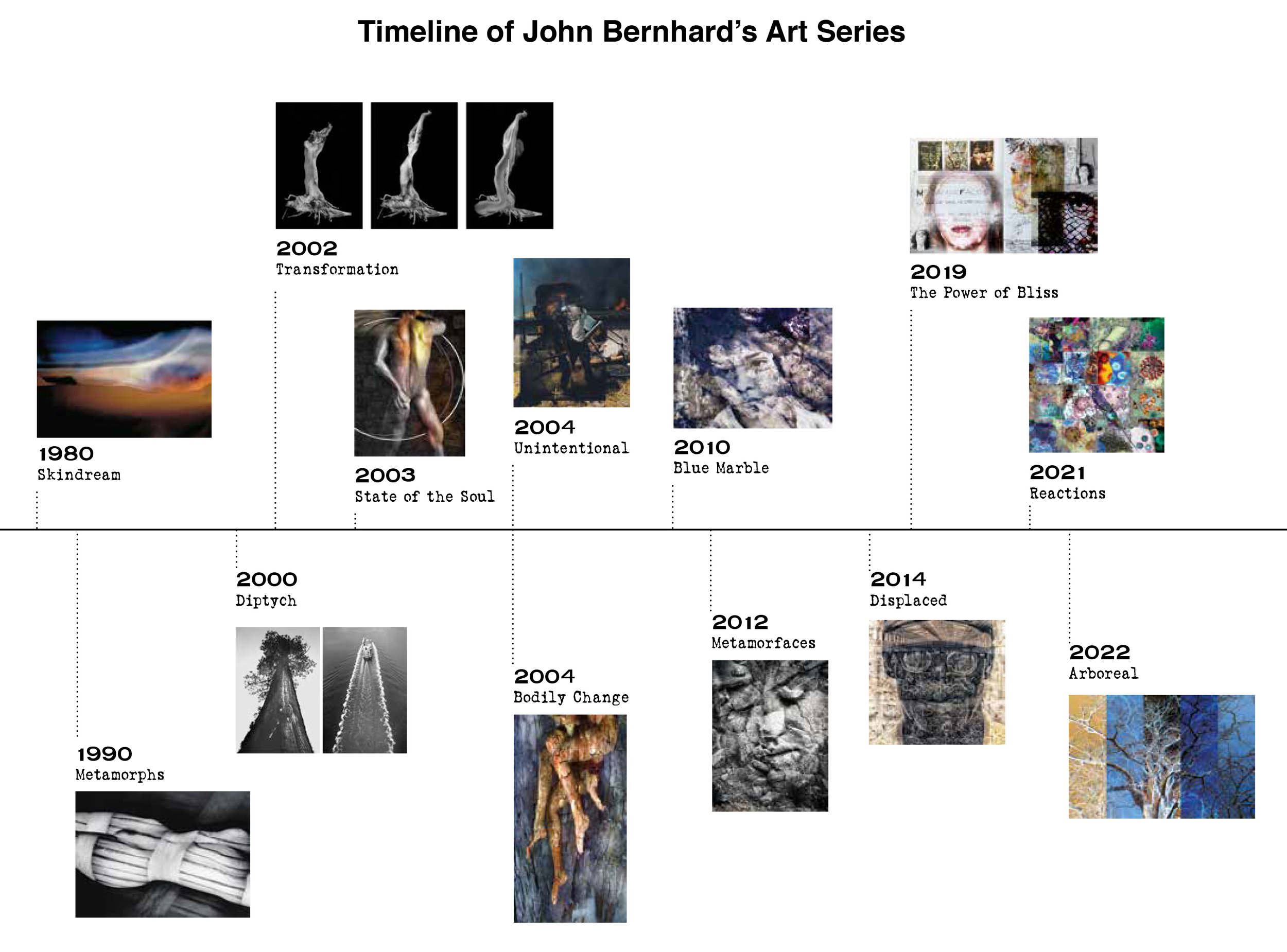
Curatorial Timeline
Swiss-American artist John Bernhard has developed a multidisciplinary practice spanning photography, collage, painting, and writing. Across four decades, his work has evolved from surreal explorations of the human body to a contemplative engagement with trees as symbols of memory, transformation, and ecological awareness.
1980s–2010s
The Transforming Body
Bernhard’s early work explores the human body as a site of metamorphosis, drawing from surrealist traditions and poetic abstraction.
Key series:
• Skindream – lyrical color studies of the nude body
• Metamorphs – black-and-white transformations of the human form
• Transformation – mystical apparitions emerging from the figure
• État d’Âmes – emotional states embodied through gesture and atmosphere
• Bodily Change – photography, collage, and painting suggesting altered bodies
These works establish a recurring theme in Bernhard’s practice: identity as fluid and continually evolving.
2010s–2020s
Faces and Social Presence
Bernhard shifts from the body to the face, using portraiture to explore psychological depth and social identity.
Key series:
• Metamorfaces – portraits of women exploring identity and transformation
• Blue Marble – intimate portraits of children reflecting on their fragile future
• Displaced – portraits of homeless men confronting social invisibility
Here the human face becomes a landscape of emotion and lived experience.
2000s–2004s
Conceptual Dialogues
Bernhard’s work becomes increasingly conceptual, focusing on relationships between images rather than individual photographs.
Key projects:
• Unintentional – unexpected visual encounters discovered rather than staged
• Diptych – paired images forming visual and philosophical dialogues
• Drift – an essay exploring the poetics of image relationships and narration
This period reflects a growing interest in visual thinking and narrative structure.
2020s–Present
Arboreal Consciousness
In his mature work, Bernhard turns toward trees as a symbolic and ecological language.
Key series:
• Arboreal – meditative studies on trees, care, and awareness
• Cartoon Arborealis – reinterpretations of arboreal imagery toward a language of trees
• What Persists – reflections on trivial imagery from the living world
These works shift attention from the human figure to the living structures of nature, positioning the tree as a metaphor for memory, transformation, and resilience.
Statements
SKINDREAM
Beyond mere Beauty and Eroticism
The color photographs in this series originate from my early work in the 1980s, a formative period of exploration shortly after I settled in Texas. Immersed in this vast and energetic landscape, I absorbed the spirit and optimism of the American Dream, an atmosphere that infused my work with a new sense of freedom and creative momentum.
In this series, I sought to evoke a new vision of the female body. Through layered imagery and atmospheric compositions, the body becomes both subject and landscape, shifting between reality and imagination. The resulting images are at once surreal and sensually charged, suggesting the body as a mysterious terrain, a dreamlike realm open to interpretation.
The series was first exhibited in 1994 at the Millioud Gallery in Houston as part of FotoFest.
Date: 1978 -1980 Archival print and color print Edition: 10 Size 14x11 / 40x30 (inches)
METAMORPHS
The Phantasm of the Transformation
The Metamorph series originated from a commercial assignment in which I projected photographic images onto a white cylindrical surface. Fascinated by the distortions and layered effects produced by this process, I began applying the technique to the human figure, particularly the female body. By projecting photographs of natural elements onto the figure, the body becomes a surface where human presence and the textures of the earth merge.
Through these layered projections, the figure transforms into a shifting terrain suspended between reality and imagination. The work explores transformation as an essential condition of life. Change unfolds constantly, often unnoticed, yet when we become aware of it, it can feel both captivating and unsettling.
By bringing together two distinct visual realities within a single image, the work introduces a quiet tension that invites reflection on the nature of transformation.
Date: 1990 -1999 Gelatin silver print and archival print Edition: 10 Size 11x14 / 16x20 / 20x24 (inches)
TRANSFORMATION
Mystic apparitions
The Transformation series reflects my belief in a dialogue between the human body and the forces of nature: evolution, the passage of time, and the continual transformation of body and mind. The work grew from my early exploration of transformation in the Nudes Metamorphs series and later merged with structural ideas developed in my Diptych work. In many sequences, the first and last images echo the presence of a diptych, while the photographs in between unfold as a gradual evolution.
Forms shift, mutate, and dissolve, creating a visual experience of unstable realities. The human body moves through the mystique of change, becoming both subject and landscape.
Within these images, trees or animals appear transported into another dimension through the transformed body, suggesting a transitional state of being where nature, time, and human presence converge.
Date: 2002 -2004 Archival print Edition: 10 Size 11x14 / 16x20 / 20x24 (inches)
ETAT D'AME
State of the Soul
État d’Âme marks the first time in my work that I turned the camera toward men. Known primarily for photographing the female body, this series represents a shift toward exploring masculinity and male identity.
The work examines manhood in all its complexity, reflecting the inner tensions that shape contemporary male identity. Many men today find themselves questioning inherited notions of strength, authority, and self-definition. Masculinity emerges here not as a fixed condition but as a shifting state of mind and spirit.
Within the broader progression of my work, often centered on transformation and the mutable nature of identity, État d’Âme turns inward. The images suggest a quieter measure of manhood rooted in introspection, vulnerability, and the evolving landscape of the soul.
Date: 2004 -2005 Gelatin silver print and archival print Edition: 10 Size 11x14 / 16x20 / 20x24 (inches)
BODILY CHANGE
The suggestion of an altered body.
The Bodily Change series explores the suggestion of an altered body. It grew from Skindream, an earlier body of work, and gradually evolved through a dialogue with ideas first developed in my Metamorphs, and Transformation series. Within the progression of my work, this series continues an ongoing investigation into transformation and the shifting relationship between the human body and its environment. The body becomes a site of transition where identity, nature, and time intersect.
Through layered compositions, I arrange colors, textures, and found backgrounds much like paint on a canvas. Using projection and superposition, the body becomes a shifting surface of imagery. Freed from its physical constraints, it dissolves into its surroundings, merging with natural forms and transforming into dreamlike, sometimes abstract presences.
Date: 2005 -20013 Mixed media/acrylic and archival print Edition: 10 Size 11x14 / 16x20 / 20x24 / 20x30 (inches)
METAMORFACES
In the MetamorFaces series, my attention shifts from the body to the female face. The portraits present a fusion of human features with layers of natural textures and materials. Surfaces of wood, stone, and other organic elements intersect with the face, creating images that hover between portraiture and abstraction.
Through these visual interweavings, the face becomes a landscape where inner life and the material world intersect. Familiar features are altered and reimagined, inviting the viewer to look beyond conventional portraiture and consider the deeper forces that shape human presence.
In a culture saturated with images of flawless, youthful beauty, these portraits seek to challenge that narrow ideal. By reshaping the face through layered imagery, the work reveals the subtle imprint of time and the elemental forces that shape who we are, beyond the surface of appearance.
Date: 2012 -2020 Archival print on canvas, wood, tile, plexiglass, found material, etc. Edition: 3 Size 11x14 / 20x30 (inches)
BLUE MARBLE
Environmental Destruction Through the Eyes of Children
Climate change, pollution, and the way we treat our planet have become urgent global concerns. This series reflects my personal commitment to raising awareness through photography and to expressing concern for the world we are leaving to the next generation.
The background landscapes originate from NASA photographs taken by astronauts aboard the International Space Station. I searched through NASA’s image archives for views of regions visibly affected by pollution or environmental degradation, selecting images that reveal the fragile and constantly transforming surface of our planet.
I then digitally enhanced these landscapes and superimposed portraits of children from different parts of the world whom I had photographed over the years. Their innocent faces emerge within these altered landscapes, bearing witness to a planet in profound transformation and reflecting the fragile future that awaits them.
Date: 2011 -2012 Archival ink on torn cotton rag paper (recycled wood frame optional) Edition: 3 Size 30x20 / 60x40 (inches)
DIPTYCH
A work made up of two matching parts
I was ransacking through my library files when I came across these two photographs (plate 24) and was struck by their similarities. Both have their arms up, leaving the right hand in the frame and placing the subject slightly to the left. I wondered why I was prompted to take these photos, and I began the mission of looking through the entire body of my work. I was so excited to find that different subjects were approached using similar compositions and moods that I pursued my search for more than three years.
I wanted to convey a feeling of discovery and gratification but realized that some photographs gave a sense of tension as if the subjects were in opposition. The interaction of the two images often produces ambiguous feelings. In the creation of an image, I believe that we react in a field of association with repetitions, analogies, and duplicities. In any given situation - from time to time, place to place, and subject to subject - the image maker will subconsciously encounter similar approaches. Intuitive action brings the affinity of the subject matter to a new level of significance. This series of diptychs constitutes an excellent demonstration of the use of repetition in idea or in form when moods are analogous.
Date: 2003 Archival print Edition: 10 Size 16x20 (inches)
UNINTENTIONAL
Unintentional Lithographs: Cheating Creativity
In 2004, while in China overseeing the printing of one of my books, I noticed discarded make-ready sheets from previous print jobs piled in a large trash bin. Curious, I pulled out a few. To my surprise, the overlapping fragments of images formed unexpected compositions that closely resembled the layered visual language of my own work. Intrigued, I began searching for more.
The meaning that emerged from these accidental pairings was so compelling that I salvaged several sheets. What I discovered was an unusual body of work created without intention, authorship, or control. The images had been printed at random; my only role was deciding which ones to preserve.
After decades developing a personal vocabulary based on collage and layering, it was striking to encounter images that echoed my aesthetic yet were created entirely by chance. These works were unplanned, unrepeatable, and deeply resonant.
Date: 2004 Sheet-fed print 8x10 (inches)
DISPLACED
With the Displaced series, I seek to draw attention not only to homelessness but also to the decline of American manufacturing and the profound job losses that have accompanied it. For the first time since the Industrial Revolution, fewer than ten percent of Americans work in manufacturing, a shift that has reshaped communities and livelihoods.
I traveled throughout the United States to meet and photograph people experiencing homelessness. The work presents a surreal and abstract interpretation of the individuals I encountered. Through my characteristic layered process, I merge portraits of homeless men with photographs of abandoned manufacturing plants, allowing the faces and industrial structures to intersect within the same image.
The final works are printed with UV-cured archival inks fused onto metal sheets, echoing the material presence of America’s industrial past.
Date: 2012 -2014 UV curable archival inks on metal Edition: 5 Size 30x30 (inches)
ARBOREAL
The Arboreal series emerged from my return to the world following the extended confinement of the COVID-19 pandemic. The series marks a new evolution in my work. For the first time, the human body and face are absent, leaving nature as the sole subject. Drawing on my long-standing fascination with trees, an element that has appeared in many of my earlier series, I turned my attention fully to the natural world.
Through experimental photography, collage, and photomontage, I explore the amazing vitality of trees and the energies that connect humans and nature. The layered compositions evoke endurance and regeneration while recalling the historical reverence for forests across cultures.
In a time marked by disconnection and environmental uncertainty, Arboreal invites a renewed awareness of trees not simply as landscape, but as living presences deserving of care and attention.
Date: 2020 -2026